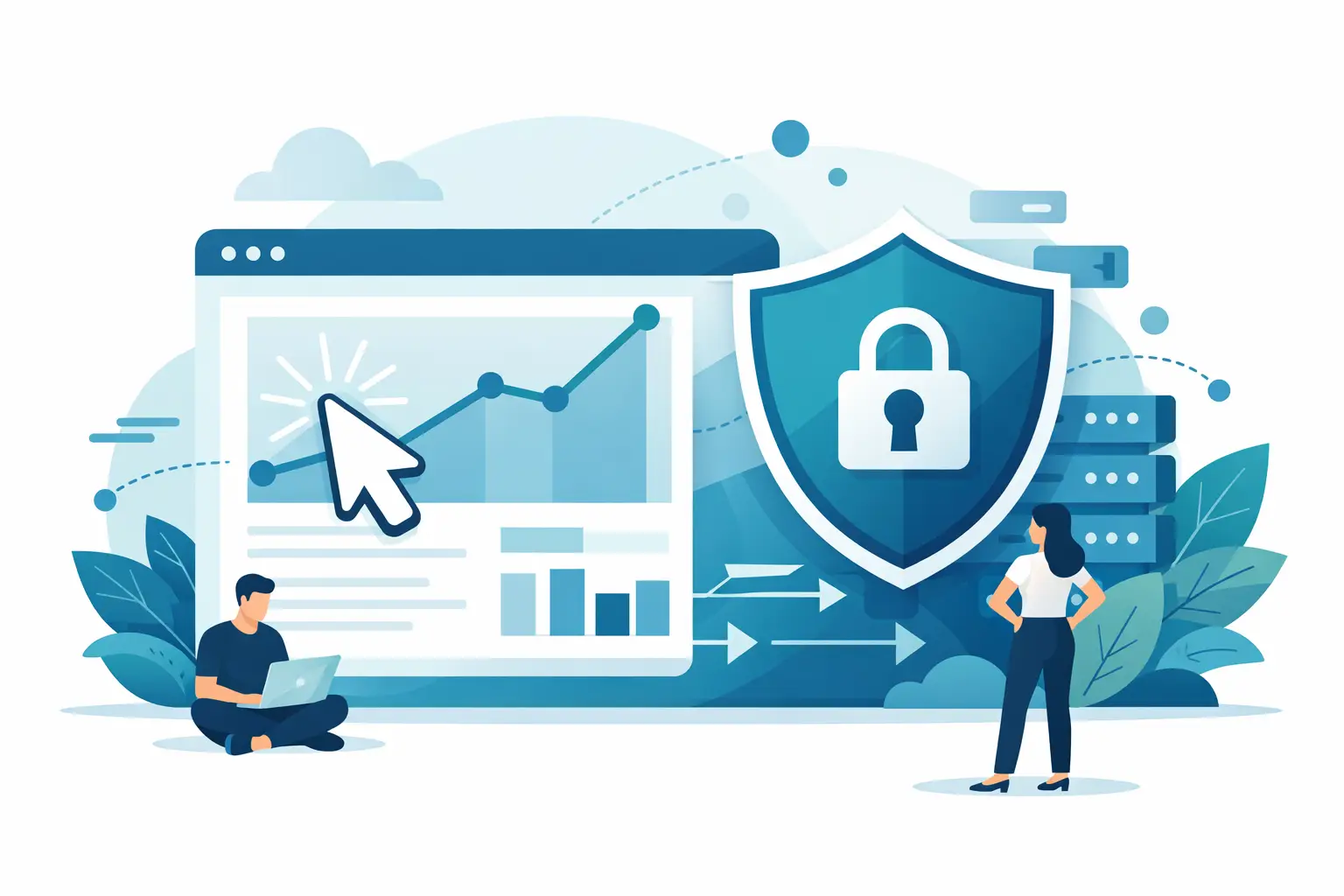
Privacy safe click tracking helps you measure engagement and conversions without exposing personal data or creating compliance headaches.
A lot of teams learn this the hard way: the moment you start asking useful questions about clicks, privacy risk shows up right beside the data. Which CTA gets attention? Which outbound link sends qualified traffic? Where do users hesitate before converting? Those are valid business questions, but the old way of tracking them often collected more than it needed. Privacy safe click tracking fixes that problem by focusing on behavior, not identity.
What privacy safe click tracking actually means
At its core, privacy safe click tracking records click events without turning visitors into profiles you can personally identify. You still see what was clicked, when it happened, where it happened on the page, and whether it contributed to a goal. What you avoid is collecting unnecessary personal data, exposing sensitive page content, or creating a system that depends on invasive tracking practices.
That sounds simple, but the difference matters. Traditional analytics setups often relied on persistent identifiers, third-party scripts, broad data collection, and long retention periods. They were built to capture as much as possible first and sort it out later. A privacy-first approach flips that model. It starts with a tighter question: what is the minimum data needed to understand user behavior and improve the site?
For most businesses, that is enough. You do not need a visitor's full identity to learn that a pricing page button underperforms, that footer links drive more outbound clicks than expected, or that users repeatedly click a non-clickable image because they think it should lead somewhere.
Why click tracking needs a privacy-first approach
Click data is more revealing than many teams expect. A single event may look harmless, but patterns across pages, sessions, and destinations can quickly become sensitive if the setup is careless. This is especially true on websites that include account areas, checkout flows, health-related content, finance pages, or internal tools.
The risk usually comes from context, not just the click itself. If a tool captures full URLs with query parameters, button labels containing personal details, form interactions, or page content near the click, the dataset can become difficult to defend from a compliance standpoint. The same issue appears when session replay or heatmaps are enabled without proper masking.
That is why privacy safe click tracking is not just about one feature. It is about how event collection, storage, masking, and reporting work together. A click event should help you understand intent and performance. It should not expose names, emails, payment details, or anything else that was never necessary for measurement.
The business case is stronger than it used to be
For a long time, some teams treated privacy as a trade-off. More privacy meant less insight. Less privacy meant better optimization. That argument has aged badly.
Most teams do not fail because they lack raw data. They fail because their analytics are too fragmented, too noisy, or too risky to trust. When a dashboard is flooded with over-collected data, simple questions become harder to answer. Worse, the people responsible for marketing or product performance end up relying on numbers they do not fully understand.
A cleaner tracking model often performs better in practice. It is easier to implement, easier to explain internally, and easier to use consistently. You get focused event data on link clicks, CTA clicks, navigation behavior, and conversions without carrying the operational burden of invasive tracking. That means faster decisions, fewer compliance concerns, and more confidence in the data you act on.
What good privacy safe click tracking looks like
The best setups are boring in the right ways. They are predictable, intentional, and controlled.
It tracks events, not people
You want to know that a button was clicked, not who someone is in real life. Good systems emphasize event-level visibility and anonymized visitor history instead of building identifiable user dossiers. That still gives you meaningful behavioral insight across pages and sessions while reducing risk.
It masks or avoids sensitive details automatically
A privacy-safe platform should not make you manually chase every edge case. Sensitive fields, personal content, and private inputs should be hidden by default or excluded from collection. This matters even more if you use session replay or detailed visitor monitoring alongside click data.
It supports compliance without making setup painful
If your analytics tool requires a legal deep dive every time you add a tracked button, something is broken. Teams need practical controls that support GDPR, CCPA, and PECR alignment without turning implementation into a project that never ships.
It keeps reporting useful
Privacy protection should not leave you blind. You should still be able to segment clicks by page, source, campaign, device, referrer, and outcome. You should still be able to connect click behavior to goals and conversion activity. Otherwise, the tool is technically safe but operationally weak.
Where teams usually get it wrong
The most common mistake is overcollection. Teams track every click, every attribute, every parameter, and every possible variation because they might need it later. In reality, that creates clutter and risk. Start with the actions that matter to the business: primary CTAs, outbound links, navigation elements, pricing interactions, sign-up steps, and lead or purchase goals.
Another problem is treating click tracking as separate from the rest of behavioral analytics. A click on its own tells only part of the story. Was it the first interaction or the fifth? Did it happen after a scroll? Did it lead to a conversion or a drop-off? Did users rage-click because the element looked broken? Click tracking becomes far more useful when it sits alongside heatmaps, replay, real-time monitoring, and goal tracking.
There is also a false sense of safety that comes from self-hosting or first-party collection alone. Those choices can help, but they do not automatically make a setup privacy-safe. If the underlying logic still captures sensitive content or unnecessary identifiers, the risk remains.
How to evaluate a privacy safe click tracking tool
If you are choosing a platform, look past the homepage claims. Ask what is actually collected, what is masked, how long data is retained, and what controls you have over event detail.
A strong tool should let you measure outbound clicks, CTA performance, and on-page interactions without requiring custom engineering for every basic use case. It should also make it easy to understand data quickly. Most small and mid-sized teams do not need another analytics stack with a steep learning curve. They need a clear dashboard that shows what people clicked, what happened next, and where to improve.
It also helps to look for flexibility. Non-technical teams need easy setup and readable reporting. Developers may want custom parameters, API access, exports, or custom domains. The right platform can serve both without forcing either group into a compromise.
This is where a product like Traffnalytics fits naturally. The value is not only that it tracks clicks. It is that click data sits inside a broader privacy-focused system designed to show user behavior clearly while keeping private details protected.
The trade-offs are real, but manageable
Privacy safe click tracking does involve choices. You may give up some user-level granularity compared with aggressive tracking models. Some attribution paths may be less detailed. Certain advanced profiling tactics become off-limits.
For most businesses, that is a fair exchange. The data you keep is cleaner, more defensible, and more aligned with what your team can actually use. If your job is to improve pages, reduce friction, and increase conversions, you need trustworthy behavioral signals more than surveillance-level detail.
The practical question is not whether you can collect more. It is whether more collection leads to better decisions. Often it does not.
Privacy safe click tracking as a growth tool
When teams stop worrying about whether their analytics setup is exposing too much, they spend more time improving the site. That is the real upside.
You can test CTA placement, compare navigation patterns, monitor outbound partner clicks, spot dead links, and understand where conversion intent rises or fades. You can watch how visitors move through the page, connect those actions to goals, and refine the experience with less guesswork.
That is what good analytics should do. Give you control. Keep the data useful. Reduce avoidable risk.
Privacy safe click tracking is not a stripped-down version of real analytics. Done well, it is a smarter model for teams that want answers without the baggage. If you are building a site that needs to perform and a data practice you can stand behind, that is a strong place to start.