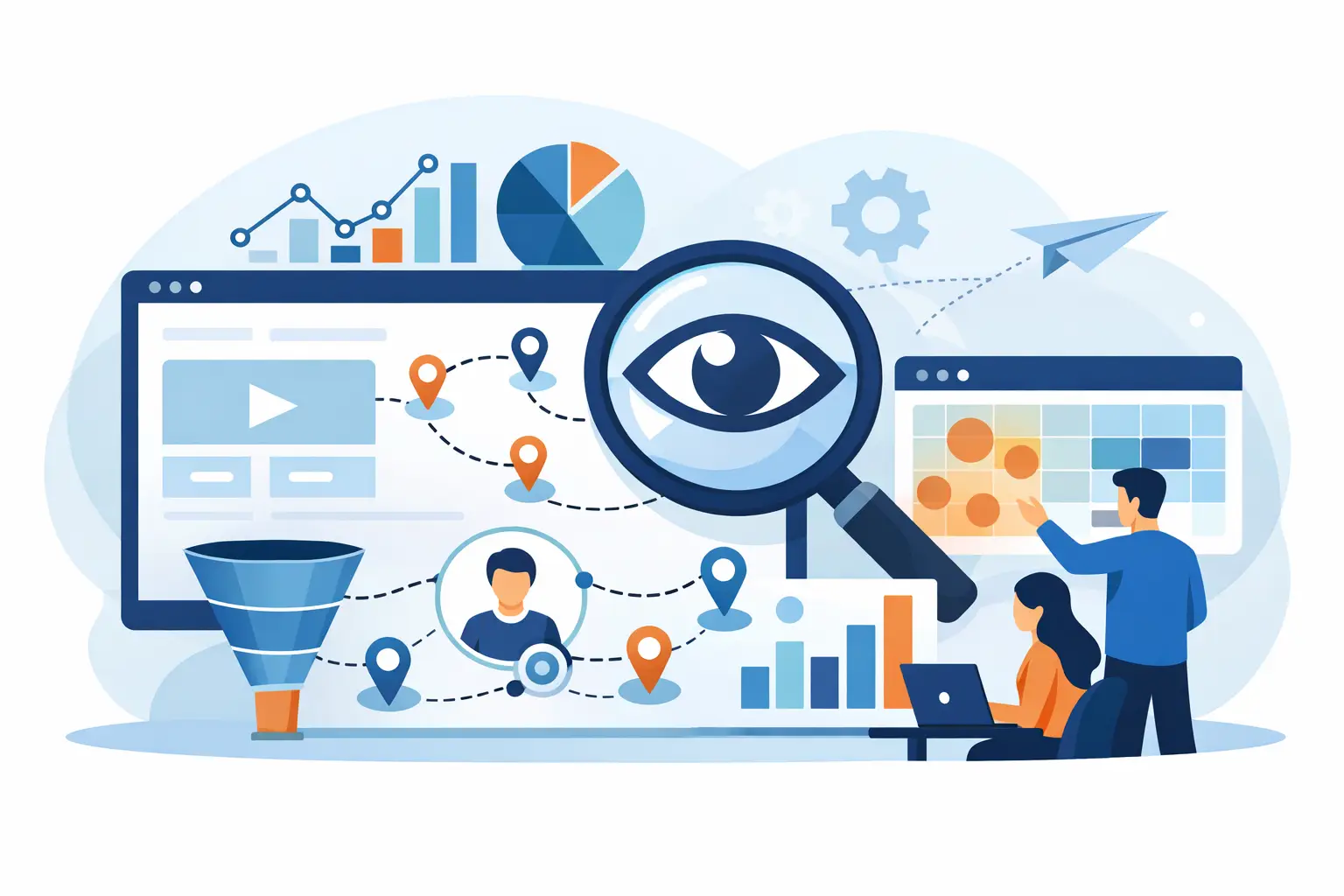
Visitor journey analytics shows how people move, click, and convert on your site, so you can fix drop-offs, improve UX, and stay privacy-conscious.
A traffic spike looks good in a dashboard until you realize almost nobody reached the page that matters. That is the gap visitor journey analytics is meant to close. It does not stop at pageviews or top sources. It shows how people actually move through your site, where they hesitate, what they click, and why some visits turn into results while others disappear.
For small and mid-sized teams, that difference matters fast. You do not need more charts for the sake of charts. You need a clear view of what happened between the first visit and the conversion, signup, sale, or exit. When you can see that path, you can make better decisions without guessing.
What visitor journey analytics actually means
Visitor journey analytics is the practice of tracking and interpreting the sequence of actions people take across your website. That includes entry pages, page transitions, clicks, scroll behavior, repeat visits, outbound clicks, conversions, and abandonment points.
The key word is journey. Traditional analytics often tells you what happened in aggregate. Journey analysis tells you how it happened. Instead of seeing that a landing page had a 62% bounce rate, you can start asking better questions. Did visitors arrive from the wrong campaign? Did they stall on a form? Did mobile users miss the main call to action? Did they click an external link and leave before reaching a product page?
That shift matters because most website problems are not isolated to one page. They happen across a chain of decisions. A homepage may be fine on its own, but if visitors consistently move from homepage to pricing to FAQ and then leave, the issue may be pricing clarity, missing reassurance, or friction in the next step.
Why pageview reports are not enough
A pageview report can tell you where traffic is landing. It cannot fully explain intent or friction. You might know that your blog drives visits and that your checkout page underperforms, but that does not mean you understand the gap between the two.
This is where teams often overreact. They redesign pages, rewrite copy, or increase ad spend before identifying the actual break in the journey. Sometimes the problem is obvious once you look at behavior. Visitors may be clicking a non-clickable element. They may be stopping at a long form field. They may be revisiting the same pricing section because the information is unclear.
Visitor journey analytics gives context to performance data. It helps you see not just what changed, but where the experience broke down.
What good visitor journey analytics should show
Useful visitor journey analytics should make the path easy to follow without turning analysis into a technical project. At a practical level, there are a few signals that matter most.
First, you need entry context. Where did the visitor come from, what page did they land on, and what happened next? A high-intent visitor from organic search behaves differently from a cold visitor from a social campaign. If those paths are blended together, you lose clarity.
Second, you need behavior inside the visit. That includes page flow, click activity, heatmaps, scroll depth, and session replay. Flow alone can show sequence, but not confusion. Replays and heatmaps add the missing layer. They show whether people are engaging with key elements or getting stuck.
Third, you need conversion context. A journey is only useful if it can be tied to outcomes. That means goal tracking, form completions, signups, purchases, or any other action that matters to the business. Otherwise, you are watching movement without measuring value.
Fourth, you need repeat-visit visibility. Many conversions do not happen in one session. A visitor may discover your site on Monday, compare options on Wednesday, and convert on Friday. If every visit is treated like an isolated event, the story is incomplete.
Finally, you need privacy controls built in. Behavioral visibility should not require invasive tracking. For many businesses, especially those serving privacy-aware audiences or operating under GDPR, CCPA, and PECR expectations, that is not a side concern. It is part of choosing the right analytics setup.
The most common use cases
Most teams do not need journey analysis for academic reasons. They need it to solve specific problems.
One common use case is conversion leak detection. You know traffic is arriving, but signups or purchases are lower than expected. Journey data helps you find where people fall away. Maybe they leave at the pricing page. Maybe they reach the form and stop. Maybe they click out to a third-party site and never return.
Another use case is landing page validation. Campaign traffic can look healthy on the surface, but behavior often tells a different story. If visitors land on a page and immediately scroll, hesitate, and exit, the message likely does not match the source intent. You do not always need a new campaign. You may need a better first screen.
Journey analysis is also useful for content-to-conversion paths. Publishers, SaaS teams, and service businesses often rely on educational pages to drive pipeline. The challenge is understanding whether readers move from content to product pages, lead magnets, demos, or contact forms. If they do not, the issue may be weak internal pathways or unclear next steps.
It also helps with UX decisions. Teams often debate navigation, layout, and call-to-action placement based on opinion. Visitor behavior gives you evidence. You can see which elements attract attention, which sections get ignored, and where people change direction.
Where teams get it wrong
The biggest mistake is treating visitor journey analytics as a feature instead of a decision tool. Collecting replays, heatmaps, and click data is easy. Turning that into action takes discipline.
Another mistake is focusing only on extreme behavior. Teams notice rage clicks, dead clicks, or obvious drop-offs, which is useful, but subtler patterns often matter more. If a large share of visitors pause at the same point, revisit the same section, or loop between two pages, that is a signal. It may not look dramatic, but it often points to uncertainty.
There is also a risk in over-instrumenting. More data is not always better. If a dashboard tracks everything, teams stop paying attention to what actually moves the business. Start with the journey to one meaningful outcome, then expand.
Privacy can be mishandled too. Behavioral analytics should help you understand visitors, not expose them. Tools that anonymize tracking, hide private details automatically, and support compliance are often the better long-term choice, especially for growing businesses that want control without adding legal risk.
How to make visitor journey analytics useful
Start with one high-value path. That might be homepage to pricing to signup, article to demo request, or landing page to checkout. If you try to map every possible route at once, the analysis becomes noisy.
Then define the moments that matter. What counts as progress? What counts as hesitation? What counts as failure? For one business, an outbound click may be a qualified lead action. For another, it is an exit problem. Context changes the interpretation.
Next, combine macro and micro views. Use reporting to identify where performance changes. Then use heatmaps, visitor history, and session replay to understand why. This is where an all-in-one approach helps. Fragmented tools create fragmented answers.
After that, look for patterns across segments. Compare mobile and desktop behavior. Compare paid and organic traffic. Compare new and returning visitors. The same journey can fail for different reasons depending on the audience.
Most important, turn findings into specific changes. Shorten the form. Move the call to action higher. Clarify pricing language. Reduce competing links. Test a different content-to-product handoff. Journey analysis matters when it changes what you build or publish next.
Why privacy-first journey analysis is a better fit for modern teams
There is a practical reason privacy-first analytics is gaining ground. Many teams want behavior insight, but they do not want a bloated stack, a complex setup, or tracking practices that feel out of step with user expectations.
A simpler model works better. You should be able to see real visitor movement, monitor conversion activity, review anonymized visitor history, and export the data you need without turning implementation into a major project. That balance is especially useful for lean marketing teams, founders, publishers, and developers who need visibility now, not six weeks from now.
That is also where platforms like Traffnalytics fit naturally. The value is not just that you can watch behavior. It is that you can do it in one place, with privacy controls built in, and with reporting that stays understandable.
Visitor journey analytics is most useful when it reduces uncertainty. It helps you stop arguing over assumptions and start improving the paths your visitors actually take. If you can see where intent strengthens, where friction starts, and where conversions break, you are in a much better position to make the next change count.
The goal is not to know everything about every visit. It is to know enough to remove friction, protect privacy, and give people a clearer path forward.